
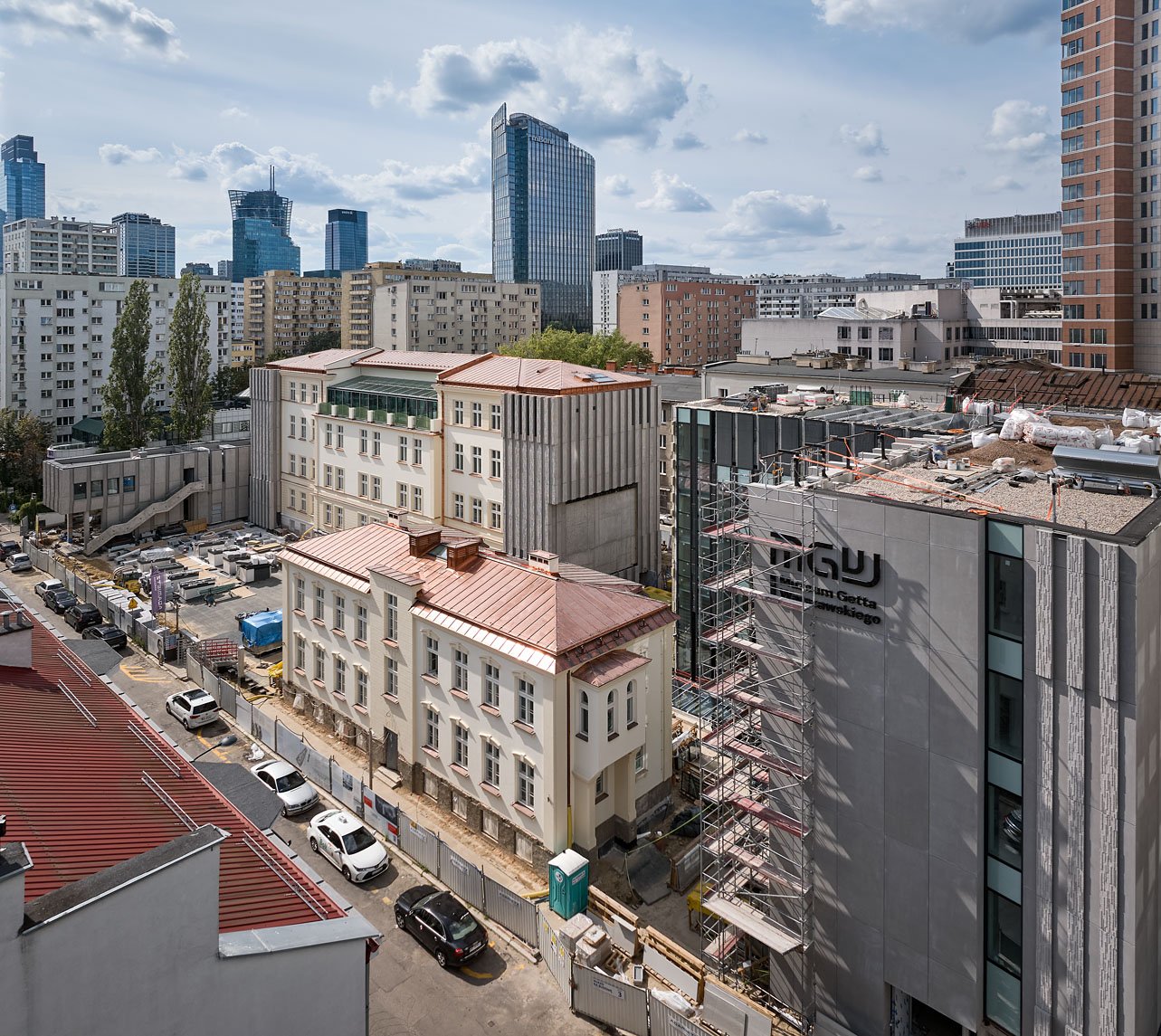
In one year, Warsaw is expected to open a new museum dedicated to one of the most important and difficult chapters in the history of the city: the Warsaw Ghetto and the fate of Polish Jews during the Holocaust. The Warsaw Ghetto Museum is being created in the historic buildings of the former Bersohn and Bauman Children’s Hospital, at 60 Sienna Street and 51 Śliska Street. It will be a place devoted not only to documenting the destruction of the Jewish community, but also to telling the story of the people who lived in Warsaw before and during the war: their everyday lives, relationships, culture, choices and attempts to survive. For us at Mówmi Studio, this opening has a particularly personal dimension. We are responsible for producing half of the films being created for the museum’s permanent exhibition. It is a major undertaking and an opportunity to contribute to an institution that will shape how future generations learn about the history of the Warsaw Ghetto.
A Museum Created in a Place of History
The museum’s location is far from accidental. The former Bersohn and Bauman Children’s Hospital is itself an important part of the history the institution intends to tell. Established in the nineteenth century through the philanthropic efforts of Jewish families, the hospital served children regardless of their background. During the German occupation, it found itself within the Warsaw Ghetto and became one of the most important medical institutions serving its inhabitants. Under the leadership of Dr Anna Braude-Heller, the hospital continued its work under increasingly desperate conditions. The museum’s architectural concept takes this history seriously. The historic hospital building is not simply a container for an exhibition: it is one of its central witnesses. Its architecture, restored details and original spatial character will become part of the visitor’s experience. The new museum complex will combine the renovated hospital and the former ophthalmology pavilion, which will house the Education Centre, with new administrative and technical buildings. The project also includes an open garden and underground exhibition spaces.
Nine Galleries, One History
The permanent exhibition is designed as a journey through nine thematic galleries. It begins with Jewish Warsaw and moves through the German occupation, the creation of the ghetto, everyday life behind the walls, the division of the city, the mass deportations of 1942 and the Warsaw Ghetto Uprising. The final gallery, titled “Never Again,” brings the historical narrative into a broader reflection on the consequences of hatred, exclusion and violence. The exhibition’s chronological framework extends beyond the war itself. It follows the history of the hospital and the Jewish community from the late nineteenth century through the interwar period, the occupation and the ghetto, up to 1946. The story ends with the discovery of the Ringelblum Archive, the underground archive created by a group of Jewish historians, writers and social activists who documented life and death in the ghetto. This archive is particularly important to the museum’s approach. Its creators understood that recording the experiences of people living under occupation was an act of resistance against the destruction of both human lives and memory. Their work also reminds us that the history of the Warsaw Ghetto cannot be separated from the history of Warsaw itself, or from the wider persecution of Jews in German-occupied Poland.
Whose Stories Do We Tell?
One of the most distinctive aspects of the exhibition is its focus on the voices of the victims, particularly those whose experiences have often been overlooked or marginalised in historical narratives. The museum intends to make space for the stories of women, children, refugees, displaced people, religious Jews and other groups whose experiences have not always received sufficient attention. It also acknowledges the limits of historical documentation. Some lives have left behind extensive archives; others survive only through a handful of objects, photographs or fragments of testimony. This is where the exhibition’s use of art becomes especially meaningful. The museum’s concept recognises that historical objects and documents cannot tell every story. Artistic responses can help address the gaps, not by replacing historical evidence, but by giving form to experiences that are difficult or sometimes impossible to express through conventional documentation. The exhibition will bring together original artefacts, photographs, archival documents, works of art and multimedia installations. The museum’s collection, which has been growing since 2018, already includes thousands of objects connected with Jewish life and the history of the Holocaust.
Films as Part of the Exhibition
Audiovisual storytelling will be an important part of the permanent exhibition. Films can bring historical information closer to visitors, connect individual experiences with the wider historical context and create space for voices that might otherwise remain unheard. At Mówmi Studio, we are responsible for producing half of the films prepared for the exhibition. Our work involved translating historical research and complex subjects into audiovisual narratives that can be understood by different audiences, including younger visitors. For us, this is a continuation of several years of work on documentary and educational films exploring Jewish history and heritage in Poland. We have worked on stories connected with pre-war Jewish life, the Holocaust, survival, memory and the ways in which the past continues to shape the present. Working on the museum’s films also means thinking carefully about the relationship between historical accuracy and cinematic language. How do we tell a story without simplifying it? How can we make difficult historical material accessible without losing its complexity? And how can moving images help visitors connect with individual human experiences rather than encounter history only as a sequence of dates and events? These questions are central to our work on the project.
Beyond the Museum Walls
The Warsaw Ghetto Museum is being conceived not only as an exhibition space, but also as a research, educational and cultural institution. Its activities will include school programmes, workshops, historical walks, lectures, temporary exhibitions, film screenings and international cooperation. An important part of the museum will be its multimedia centre, offering access to digital collections, interactive presentations and educational resources. The institution also plans to develop tools and experiences accessible to visitors with different needs, including people with disabilities and neurodivergent visitors. This broader educational mission matters. The history of the Warsaw Ghetto is not only a subject for historians or people already interested in Jewish history. It is also an opportunity to talk about human dignity, responsibility, solidarity, exclusion and the consequences of indifference. The museum’s final gallery, “Never Again,” gives this idea a particularly clear expression: the rejection of genocide and mass violence must apply to everyone, without exception.
One Year Before the Opening
The opening of the Warsaw Ghetto Museum will be an important moment for the city and for everyone working to preserve the memory of its Jewish past. It will also mark the beginning of a new chapter — one in which historical research, original objects, personal testimonies, art and contemporary educational tools will meet in a single space. We are glad that Mówmi Studio can be part of this process. Creating films for a permanent exhibition is a responsibility that goes beyond delivering a finished audiovisual work. These films will become part of a larger narrative encountered by visitors from Poland and around the world. We are looking forward to the moment when the doors open and the stories we have been working on become part of the museum experience.
The Warsaw Ghetto Museum is taking shape. And so are the films that will help tell its story.
Photograph by – Muzeum Getta Warszawskiego // Warsaw Ghetto Museum in Warsaw (July 2026)