
At Mówmi Studio, we often work with history. We make films about the past, memory and Jewish culture in Poland. But we value something else just as much: the opportunity to work with stories that are still unfolding. Stories in which history does not belong only to archives. Stories that still shape relationships, identities and everyday life. This August, we spent two weeks in Poland with Carmel Tanaka and her mother, Dalia Gottlieb-Tanaka. We had waited almost a year for these days.
We spent the first week in Białystok, the city where their family once lived. Then we travelled to Warsaw. Throughout the journey, we filmed, talked and followed Carmel and Dalia as they returned to places connected with their family history. But this was more than a journey through geography. It was also a journey through memory, trauma and conflicting versions of the past. And for Dalia, it meant doing something she had once said she would never do: returning to Poland.
A Return That Was Never Supposed to Happen
Dalia Gottlieb-Tanaka is 76 years old. She has limited mobility and cannot walk long distances. Before this journey, she had said that she would never come to Poland. Yet she came. As she explained, the commemoration of her family played a major role in that decision. In August, Białystok honoured members of the Atłasowicz family with three Stolpersteine. The stones commemorate Szyfra Atłasowicz, her brother Mosze and their father Abram Atłasowicz. The ceremony brought together members of the family from different parts of the world. Carmel and Dalia came from Canada. Another relative, Tracey, travelled from Texas in the US specifically for the event. For Dalia and Carmel, it was also their first opportunity to meet her.
The gathering gave the commemoration another dimension. It did not only bring the names of Szyfra, Mosze and Abram back into the streets of Białystok. It also brought together members of a family separated by war, migration, time and geography. For Dalia, however, the journey also carried a different weight.She repeatedly described it as her first and last visit to Poland. That awareness slowly became another important dimension of the documentary we are developing.
Finding a City That Has Changed
Following the history of the Atłasowicz family through contemporary Białystok was not always easy. The city looks very different today. War destroyed large parts of pre-war Białystok. Post-war reconstruction changed the city again. Streets disappeared. Buildings vanished. Entire fragments of the Jewish city no longer exist in physical space. For Carmel and Dalia, this created a strange experience. They travelled through a city connected to their family, but often had to imagine the places they were looking for.
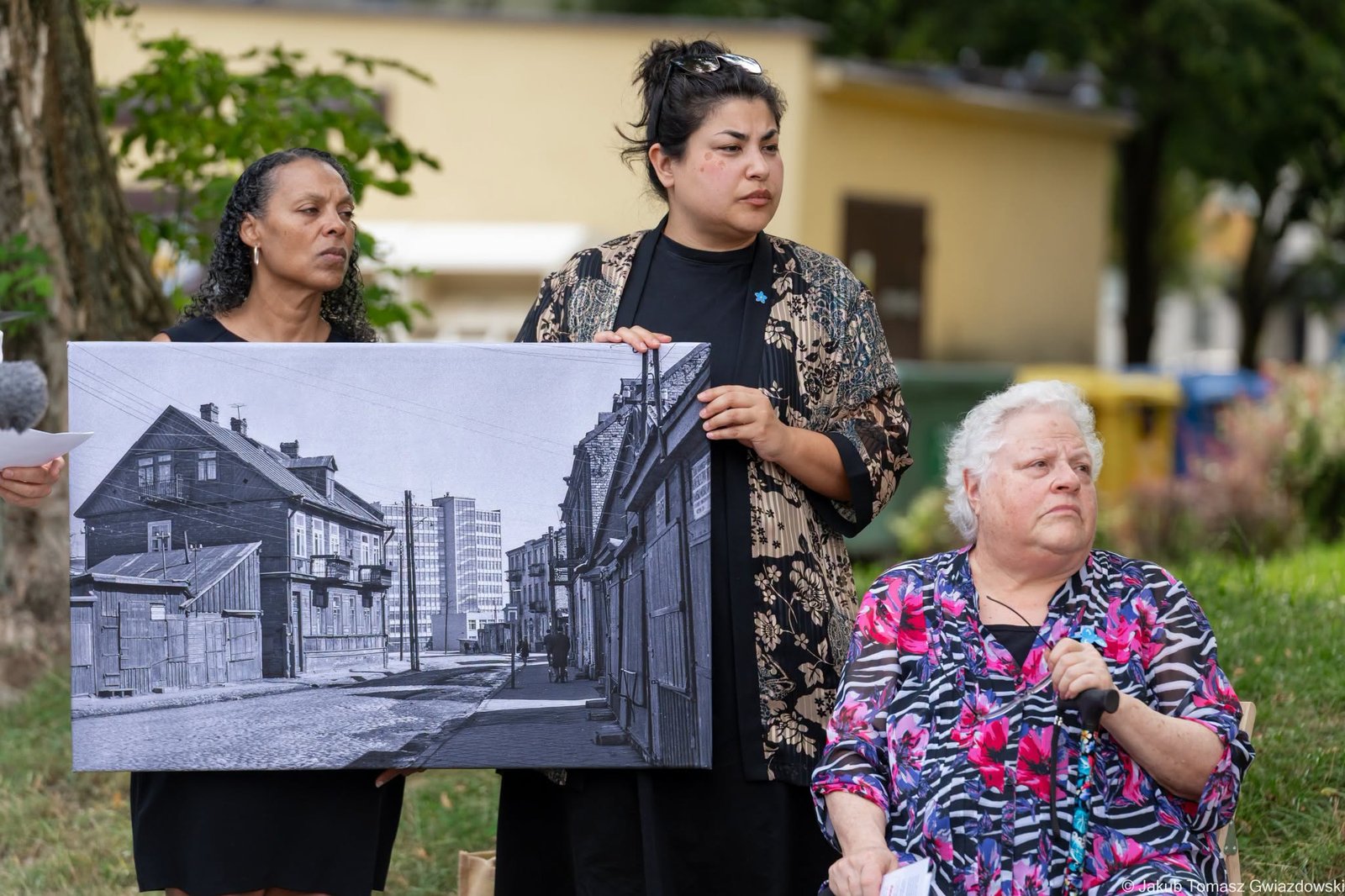
For the first time, they saw where Szyfra’s family home had once stood. The house no longer exists. It disappeared decades ago. Standing in front of a contemporary urban landscape, they had to imagine a home that belonged to another city and another time. This difficulty became part of the story itself. Memory does not always have a place to return to. Sometimes the place has disappeared. Sometimes the landscape survives, but everything inside it has changed.
A Family History With More Than One Version
During our time together, we did not simply reconstruct the history of the Atłasowicz family. We encountered different versions of it. That is one of the central themes of the feature documentary we are developing around Carmel and Dalia. At the centre of the story stands Szyfra Atłasowicz, a Jewish woman from Białystok who survived the Holocaust. Her father, Abram Atłasowicz, owned the pre-war “Białol” vegetable oil factory. During the war, Szyfra was deported to the Soviet Union. After the war, she managed to return to Białystok for several days.
She found a partially destroyed city. Almost no Jews remained. Someone else lived in her family home. These events form the basis of our short animated documentary, “Atłasowicz”. But they also raise questions that go far beyond the historical facts. How do families remember events that nobody fully explained? What happens when different generations tell the same story differently? And what happens when family memory contradicts archival documents or the testimony of the person who experienced the events?
Carmel and Dalia often approach these questions from very different perspectives. Carmel searches, reads and compares sources. She feels a strong need to understand what happened. Dalia often relies on family memory and emotional experience. Their perspectives do not always meet. Sometimes they openly contradict each other. We do not want to resolve every contradiction in the film. Instead, we are interested in what those contradictions reveal. They show how memory changes. They also show how trauma, silence and time can shape the stories that families pass from one generation to another.
The Premiere of “Atłasowicz“
During their stay in Białystok, Carmel and Dalia also watched “Atłasowicz” for the first time. We presented the film as a premiere screening. The short animated documentary tells the story of Szyfra’s return to Białystok after the war. It follows her through a city that she once knew but could no longer recognise. The film formed the conclusion of the artistic scholarship programme awarded by the Mayor of the City of Białystok to Łukasz Kamil Kamiński in the field of film, digital culture and intermedia.
For us, however, the screening also created a unique situation. The people closest to Szyfra’s story watched a film about her life. After the screening, Carmel and Dalia met with the audience at the Ludwik Zamenhof Centre in Białystok. The meeting created space for conversation about family history, memory and the different ways in which later generations relate to the past. During their stay, we also took part in a historical walk through Białystok that Izabela Szymańska prepared around the history of the Atłasowicz family. Together, these events connected private memory with public commemoration.
Can We Work With Intergenerational Trauma?
One of the strongest themes that emerged during the August filming was intergenerational trauma. The term describes the ways in which the consequences of traumatic experiences can affect later generations. These consequences do not have to take the same form in every family. They may appear through family narratives, silence, emotional patterns, relationships or attitudes towards the past. Researchers have explored these processes in families affected by genocide, war, forced displacement and other forms of collective violence. The history of Holocaust survivors and their descendants has played an important role in this field of research.
But our film does not try to offer a psychological diagnosis. Instead, we follow two women as they work through the consequences of a difficult family history in their own ways. And perhaps this distinction matters. People do not simply “heal” trauma and leave it behind forever. But they can work with its consequences. They can recognise patterns. They can speak about experiences that previous generations could not discuss. They can also try to interrupt the cycle through which unresolved pain passes from one generation to another.
Carmel has chosen art as one of the ways to approach this history. She is currently working on an autobiographical comic book based on her family’s past. Through drawing and storytelling, she returns to events that she did not experience herself but that continue to influence her sense of identity and belonging. During the journey, she also approached the past through personal and spiritual practices. These gestures do not offer historical certainty. Instead, they create a relationship with absence. Dalia’s decision to come to Poland became another form of confrontation.
A year earlier, in a report filmed with Carmel, she had said that she would never come. This time, she came anyway. The journey did not erase anger or resolve every emotion connected with Poland and the past. That was never the point. Sometimes working with trauma does not mean finding closure. Sometimes it means allowing yourself to enter a place you once refused to enter.
A Mother, a Daughter and the Passing of Time
The August filming also revealed another important dimension of the documentary. The film is increasingly about Carmel and Dalia’s relationship with time. Dalia’s physical condition limited how much she could do during the journey. She often needed to rest. Walking through the city could become difficult. At one point, she described the trip as her first and last visit to Poland. This gave the journey a different emotional weight. Carmel did not only travel with her mother through the history of their family. They also shared an awareness that time is passing.
The documentary therefore moves between several generations. There is Szyfra, whose story comes to us through memory, documents and archival recordings. There is Dalia, who carries her own memories of her mother. And there is Carmel, who tries to understand how this history shapes her own life. But there is also the present. A daughter spends time with her mother. They disagree. They remember differently. They react differently to the places they visit. And yet they share this journey. For us, this may become one of the most intimate dimensions of the film.
From Białystok to Vancouver
The August filming in Poland was possible thanks to two projects. The Big Picture Association carried out the project “History Opens. In the Footsteps of the Atłasowicz Family” (in Polish: “Historia otwiera. Śladami rodziny Atłasowicz”) with funding from the budget of the City of Białystok. The Open Education Foundation carried out the project “A Stone and Two Roads. Białystok – Vancouver – Memory” (in Polish: “Kamień i dwie drogi. Białystok – Vancouver – pamięć”), supported through the Grant Programme of the Association of the Jewish Historical Institute in Poland. These projects allowed us to document Carmel and Dalia’s stay in Poland and the events surrounding the commemoration of the Atłasowicz family. We are also developing the feature documentary within the Dok Pro programme at the Wajda School in Warsaw. The August trip followed earlier filming carried out in the summer of 2025.
Now, after filming in both 2025 and 2026, we are entering another stage of the project. We are working on the production possibilities that will allow us to continue filming. The main part of the future production should take place in Vancouver, Canada, where Carmel and Dalia live. We want to continue telling this intimate family story. We want to follow Carmel as she works with her family history. We also want to return to the relationship between Carmel and Dalia and to the questions that remain unresolved between them. Because some stories do not end when we discover what happened. Sometimes that is where the real story begins.
The People Behind the Camera
The August filming brought together a small team that followed Carmel and Dalia throughout their stay in Poland: Director: Łukasz K. Kamiński, Cinematography: Kajetan Falkowski and Production support: Aleksandra Konieczna. We spent two weeks observing, filming and listening. We followed a family as it returned to places connected with its past. But we also witnessed something more immediate. A mother and daughter travelled together. They encountered the history of their family. They met relatives they had never met before. They disagreed. They remembered. And sometimes, they simply spent time together. For us, this is what makes the project so important. History often enters our work through archives, photographs and testimonies. This time, however, history is still moving. It lives inside relationships. It changes with every generation. And it continues to ask questions that no archive can answer alone.
In the photograph: from right to left: Dalia Gottlieb-Tanaka, Carmel Tanaka and Tracye Luckie. They are all descendants of the Atłasowicz family and all of Polish-Jewish heritage. They are holding a photo of the Atłasowicz family home, once located at 10 Sucha Street in Białystok, which no longer exists.”
Photograph by – Jakub Tomasz Gwiazdowski // Białystok Municipal Office (Białystok, August 2026)