
An experimental animated documentary about a Jewish family from pre-war Białystok, created with the support of an artistic scholarship from the President of the City of Białystok.
Watch “Atłasowicz” on YouTube:
Some stories survive in photographs, documents and family memories. Others leave behind fragments: a name in an archive, a building that has changed beyond recognition, a story passed down through generations, or a silence where a memory should be. The short experimental animated documentary “Atłasowicz” grew out of an attempt to bring together some of these fragments and tell the story of a Jewish family connected with pre-war Białystok. The film was created as part of an artistic scholarship awarded by the President of the City of Białystok. At its centre are Abram Atłasowicz, the owner of the pre-war vegetable oil factory Białol, and his daughter Szyfra. Their family history becomes a starting point for a wider reflection on twentieth-century Białystok and the fate of its Jewish community during the Second World War.
Returning to the History of the Atłasowicz Family
The story of the Atłasowicz family is inseparable from the history of the city. Before the war, Białystok was home to a large and vibrant Jewish community, whose presence shaped its social, cultural and economic life. The Holocaust brought about the destruction of much of this world, leaving behind traces that are often difficult to piece together. Working on the film meant searching for those traces: historical information, archival materials and places connected with the family. It also meant confronting the gaps in the available sources. Not every event can be reconstructed, not every image can be found, and not every family story has survived in a complete form. I wanted to approach this history through the experience of one family, while keeping in view the broader historical context in which its story unfolded.
An Animated Documentary Between Archives and Imagination
From the beginning, I knew that a conventional documentary approach would not be enough. The film combines archival materials, contemporary photographic documentation of places associated with the Atłasowicz family, and digitally created and processed animated images. Animation offered a way to work with what was missing – to explore the space between documented facts, surviving memories and the limits of historical reconstruction. Rather than presenting imagined scenes as if they were archival evidence, I wanted to make the process of visual interpretation part of the film’s language. The result is a short, experimental form that moves between documentary observation and animation. It does not attempt to fill every gap in the historical record. Instead, it asks what can be done with the fragments that remain, and how images might help us approach a past that can no longer be directly witnessed.
Experimenting with AI and Having Second Thoughts
One of the most important parts of the scholarship was the opportunity to experiment with artificial intelligence tools in the creation of images, animation and sound. I used AI-supported software, to explore ways of translating historical research, archival fragments and visual documentation into animated sequences. It was an interesting and, in many ways, valuable experience. These tools made it possible to test visual ideas that would have been difficult, time-consuming or simply beyond the budget of a small independent production. They also encouraged me to rethink parts of my working process and explore new ways of combining documentary material with digitally generated images. At the same time, the experiment left me with a number of reservations.
The fact that AI can generate an image does not necessarily mean that it can create the right image – especially when dealing with historical subjects, personal memories and experiences of violence. The results can be visually convincing while remaining unpredictable, inconsistent or detached from the specific historical reality they are supposed to represent. There is also a question of control: how much influence does the filmmaker really have over the final image, and how much is determined by the limitations and internal logic of the tools? For a project concerned with the history of a Jewish family and the destruction of a world, these are not merely technical questions. They touch on the responsibility involved in representing the past. I am glad I had the opportunity to test these technologies in practice. But I am not yet convinced that AI-generated imagery should become a regular or essential part of my filmmaking process. For now, the experience has been as much about discovering possibilities as about recognising limitations. Perhaps that is the most useful outcome of this experiment: not a ready-made solution, but a better understanding of the questions I need to ask before using these tools again.
A Film Made Independently
I carried out the project independently, taking responsibility for the entire process — from developing the concept and writing the script, through historical and archival research and visual documentation in Białystok, to animation, editing and post-production. This way of working allowed me to keep the different stages of the process closely connected. Research influenced the visual language; experiments with animation raised new questions about how to approach the material; and the editing gradually shaped the relationship between historical information, images and silences. The result is a seven-minute film. Although short, it brings together several months of research and artistic work, as well as an attempt to find an appropriate visual form for a story that is only partially preserved in the available sources.
Memory, Absence and the Limits of Reconstruction
Making “Atłasowicz” was an opportunity to explore a fragment of Białystok’s Jewish history through the story of one family, but also to reflect on the challenges of representing the past. Historical research can establish facts and recover forgotten names, yet it cannot always restore the images, experiences and everyday details that have disappeared. The film does not claim to reconstruct everything that happened. It is an attempt to work carefully with what remains — and to acknowledge what is missing. I am grateful to the President of the City of Białystok for the artistic scholarship that made this work possible. It gave me the time and space to pursue an independent project, investigate a local history and experiment with a form that brought documentary research into conversation with animation. “Atłasowicz” is a small film about a family, a city and the traces left by a world that no longer exists. It is also a record of a creative process — including its experiments, uncertainties and questions that will stay with me beyond this project.
The First Screening
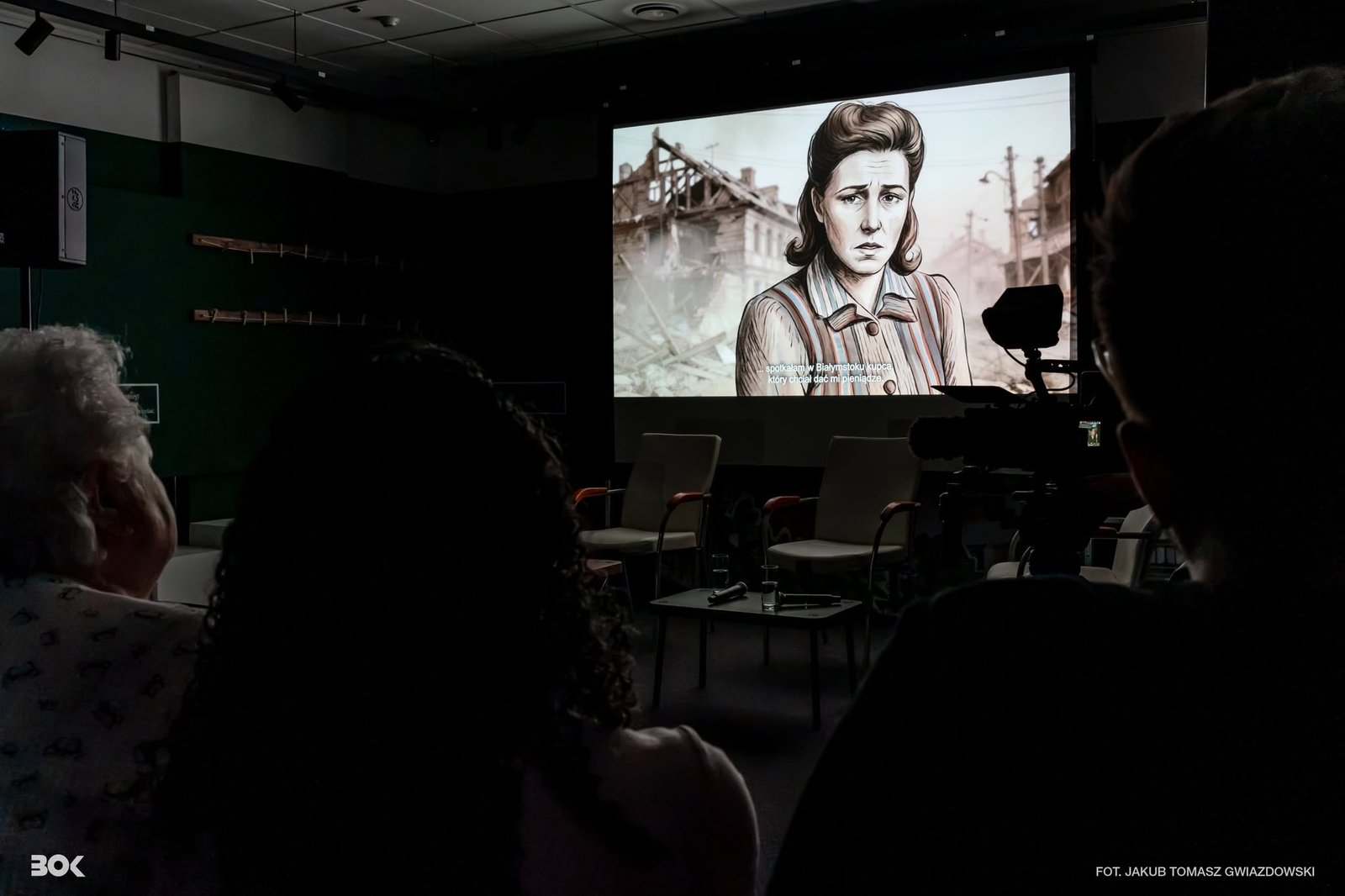
The film was presented for the first time on 14 August 2026 at the Ludwik Zamenhof Centre in Białystok. Showing it in the city connected with the history of the Atłasowicz family was particularly meaningful. The screening offered an opportunity to share the result of the scholarship with an audience in the place where the story began.
See photographs from the screening on Facebook
Photograph by – Jakub Tomasz Gwiazdowski // Białostocki Ośrodek Kultury / Centrum im. Ludwika Zamenhoffa (Białystok, August 2026)