
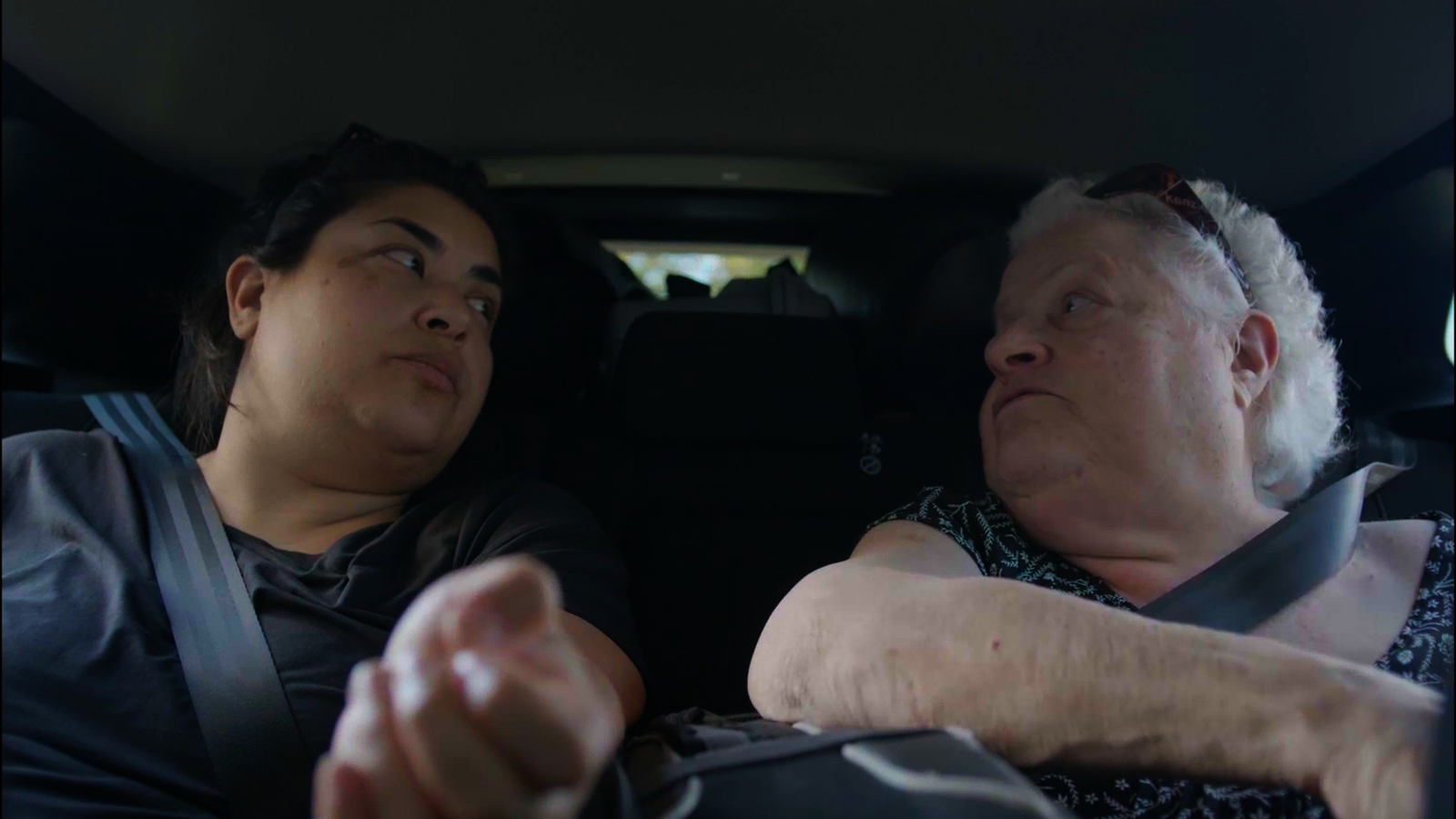
A documentary account of Carmel and Dalia’s journey to Białystok, where the commemoration of their ancestors opens up a deeply personal story of family, memory, forgiveness and belonging.
Sometimes a small gesture opens a door to something much bigger. In August 2026, we came to Białystok with Carmel Tanaka and her mother, Dalia Gottlieb-Tanaka, to commemorate their ancestors by embedding Stolpersteine in the pavement of the neighbourhood where the Atłasowicz family home once stood – the home of Shifra and her father, Avram. This was where our journey began. We were documenting an act of remembrance, a way of restoring names and lives to the city’s memory. But the stones became more than a memorial. They set something in motion: a series of encounters, conversations and emotions that none of us could have fully anticipated. What began with the commemoration of a family gradually opened into a much more intimate story. We spent almost two weeks together, following Carmel and Dalia through Białystok and other places connected to their family history. With a camera, we tried to capture not only the events and the places, but also the moments in between – the silences, the unexpected reactions, the conversations that took a different turn, and the feelings that surfaced as the past became something tangible again.
The Stones, the City and the People Who Return
Stolpersteine – literally, “stumbling stones” – are small memorials dedicated to victims of Holocaust. Placed in the pavement in front of their last freely chosen homes, they bring individual stories back into the everyday landscape of a city. They ask passers-by to pause, to look down and, perhaps, to remember someone whose life was violently interrupted. For the Atłasowicz family, these stones mark a return of sorts. The family’s story is inseparable from Białystok, even though its members were scattered across countries and continents by the events of the twentieth century. The memorial gave Carmel and Dalia an opportunity to stand in the city where their ancestors had lived and to see their names become part of its public memory. But the commemoration did not end with the stones being placed. It became the starting point for everything that followed: a walk through the city, meetings with local people, the sharing of family photographs and stories, and an opportunity to encounter a past that had long existed mainly through fragments, memories and inherited accounts.
A Story Between Three Generations
As the days went by, another story began to emerge – one that could not be marked with a stone or contained within a historical account. It was the story of three generations of Polish-Jewish women: Shifra, Dalia and Carmel – grandmother, daughter and granddaughter. Their relationship is at the heart of the film we are developing. It is a story about family memory, but also about the ways in which we understand ourselves through the people who came before us. About what gets passed down, what remains unspoken, and how differently people can experience the same family history. During our time together, we witnessed moments that seemed to open something important in both Carmel and Dalia. Their journey to Poland brought them closer to places and stories that had shaped their family, but it also brought questions about their own relationship to the surface. We became particularly interested in the space between mother and daughter: in their different ways of remembering, in the things they find difficult to express, and in the possibility of understanding and forgiving one another. We want to keep exploring this relationship in the next stages of the film. Not to force a resolution or provide easy answers, but to stay with the complexity of family bonds and the different ways we learn to live with their difficult parts.
Two Projects, One Journey
The August 2026 filming in Poland was made possible through two complementary projects. The Open Education Foundation (Fundacja Otwarta Edukacja) carried out “A Stone and Two Roads. Białystok – Vancouver – Memory” (“Kamień i dwie drogi. Białystok – Vancouver – pamięć”), supported by the Grant Programme of the Association of the Jewish Historical Institute in Poland (Stowarzyszenie Żydowski Instytut Historyczny w Warszawie). The grant made it possible to fund the Stolpersteine memorial commemorating members of the Atłasowicz family, as well as the film documentation of Carmel and Dalia’s stay in Poland and the events surrounding the commemoration. The Big Picture Association (Stowarzyszenie Big Picture) carried out “History Opens. In the Footsteps of the Atłasowicz Family” (“Historia otwiera. Śladami rodziny Atłasowicz”), funded by the City of Białystok. This project supported Carmel and Dalia’s travel to Poland and the accompanying programme of events, including a walk through Białystok and a meeting with both women at the Ludwik Zamenhof Centre (Centrum im. Ludwika Zamenhofa). Together, the two projects allowed us to bring different dimensions of remembrance into one shared experience: the public act of commemorating a family, the rediscovery of its history, and the deeply personal journey of its descendants.
The Journey Is Only Beginning
We have put together a short film offering a glimpse of Carmel’s impressions and emotions during her stay in Poland. It captures some of the moments that made this journey so meaningful, although much of what happened between the women can only be understood through the longer process of filming and getting to know one another. We are planning to continue filming with Carmel and Dalia in 2027. There is still so much to explore: the relationship between mother and daughter, the memory of Shifra, the complicated inheritance of family history, and the possibility of finding a different understanding of the past – and of one another. Looking back, the Stolpersteine were not simply the destination of this journey. They were its beginning. A gesture of remembrance set in motion a chain of encounters and emotions that has taken us somewhere we had not quite expected to go.
In the photograph: Dalia Gottlieb-Tanaka and Carmel Tanaka during the August filming in Białystok. The photograph is a still from the documentary footage recorded as part of the project.