
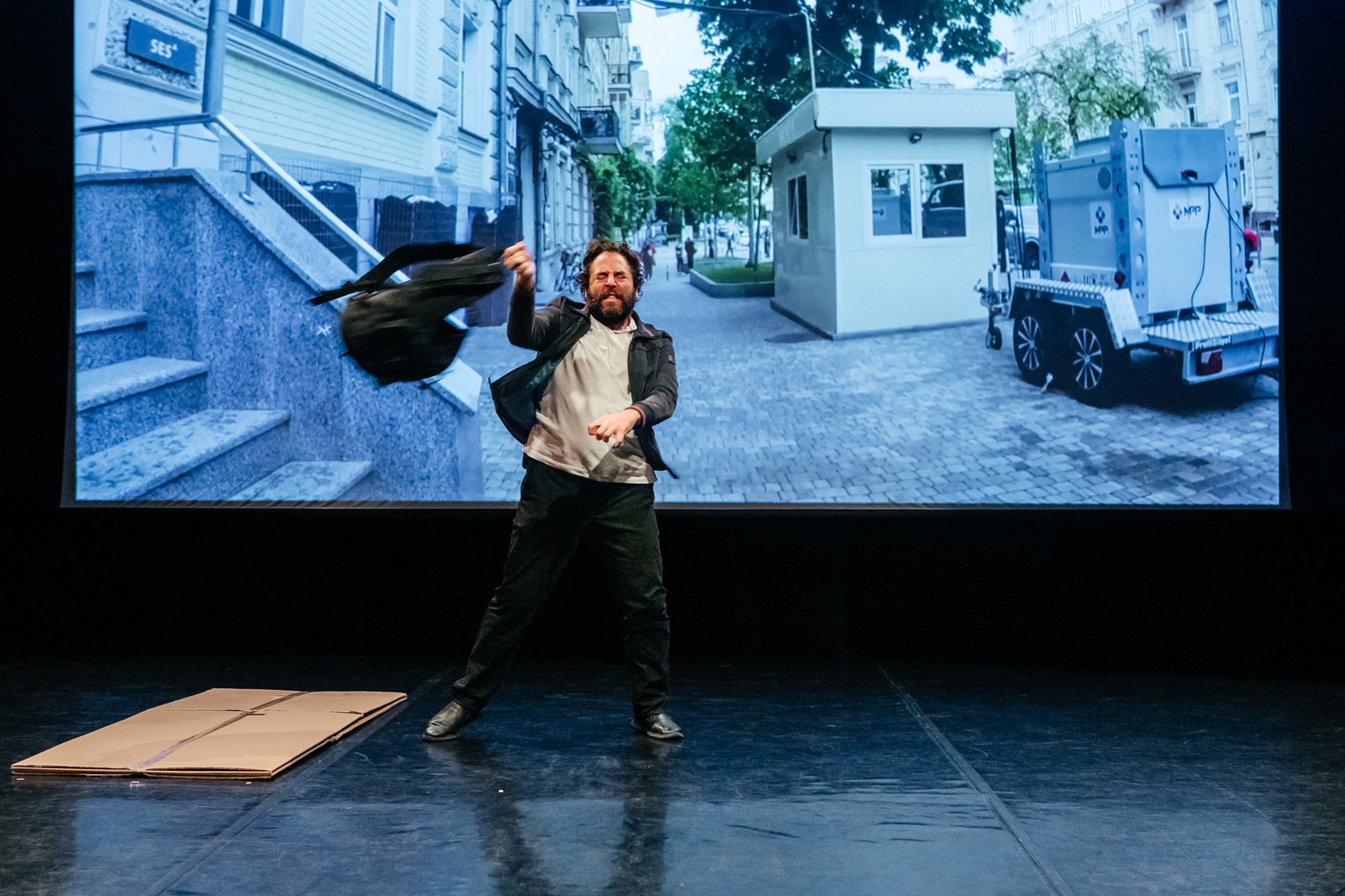
At Mówmi Studio, we are particularly drawn to projects that explore Jewish history not as something closed in the past, but as a living lens through which to understand the present. This is why we were delighted to support Warsaw based theatre director Paul Bargetto and actor Michael Rubenfeld in creating the teaser for their production, If I Had a Gun, I’d Take Them All Down.
Although our contribution focused on the audiovisual teaser, the project itself reaches far beyond the stage. It is a powerful theatrical work that brings together Jewish history, Ukrainian identity, political violence, and contemporary questions about memory, resistance, and moral responsibility.
You can watch the teaser here:
A Forgotten Jewish Figure at the Centre of History
The monodrama, written by Ukrainian artist Piotr Armianovski, takes as its point of departure the extraordinary and controversial life of Dmitry Bogrov (1887–1911) – a Ukrainian-Jewish lawyer, revolutionary, and double agent who assassinated Russian Prime Minister Piotr Stolypin during a performance at the Kyiv Opera House in 1911. Shortly after the assassination, Bogrov was arrested, tried, and executed. More than a century later, his story continues to provoke difficult questions about violence, political oppression, identity, and the limits of resistance. One of the most striking historical statements attributed to Bogrov encapsulates the complexity of his position:
“Please tell the Jews that I did not want to harm them in any way; on the contrary, I struggle for their good and for the happiness of the Jewish people.”
Rather than offering easy answers, the performance invites audiences to confront the contradictions surrounding Bogrov’s life and actions, while reflecting on the difficult ethical choices faced by individuals living under authoritarian power.
History Echoing Through Contemporary Ukraine
While rooted in events from the early twentieth century, If I Had a Gun, I’d Take Them All Down is unmistakably a work about today’s Ukraine. Created against the backdrop of Russia’s ongoing invasion, the production becomes a raw meditation on recurring cycles of violence and imperial aggression. Through innovative integration of live performance, video, and immersive sound design, audiences move simultaneously through historical Kyiv and the city as experienced today by its citizens.
Past and present constantly overlap. Bogrov’s story is not presented as a historical curiosity but as part of a much longer narrative about political violence, occupation, and the human cost of war. This dialogue between Jewish history, Ukrainian history and contemporary Ukrainian experience gives the production particular urgency, reminding audiences that questions of memory, persecution, identity, and resistance remain painfully relevant.
Theatre Beyond Conventional Storytelling
The production deliberately moves beyond traditional theatrical narration. Video design and sound become equal dramaturgical partners, expanding the stage into a cinematic and psychological landscape where documentary traces, historical memory, and personal testimony coexist. The creative team includes:
- Piotr Armianovski – author and video design
- Paul Bargetto – director & co-dramaturgy
- Michael Rubenfeld – performance & co-dramaturgy
- Natan Kryszk – sound design
- Erwin Janeralczyk – video editing
- Popesz Lang – video mapping
- Agata Pinkosz – costume design
Their collaboration creates a performance that refuses simplistic interpretations. Instead, it asks audiences to remain inside uncertainty, a space where history, memory, and contemporary conflict continually reshape one another.
Film and Theatre in Conversation
For Mówmi Studio, participating in the creation of the teaser was an opportunity to support artists whose work engages deeply with Jewish history while speaking directly to the political realities of our own time. Projects such as If I Had a Gun, I’d Take Them All Down demonstrate that stories rooted in Jewish experience are never only about the past. They continue to illuminate contemporary questions of identity, violence, displacement, and collective memory. They also remind us that film and theatre can work together to create spaces where difficult conversations become not only possible, but necessary.
Photograph by – FestivAlt