
Every year on January 27, we observe International Holocaust Remembrance Day. We return to the date of the liberation of Auschwitz-Birkenau, to the language of memory, mourning, and commemoration. We repeat familiar words: “Never again” – hoping that repetition itself will protect their meaning. But remembrance that does not disturb us, that does not demand anything from us, risks becoming ritual rather than responsibility. The Holocaust does not belong solely to the past. It belongs to culture, to education, to the ways we understand power, violence, and human vulnerability today. If remembrance is to remain meaningful, it must resist comfort. It must resist simplification. And it must resist indifference.
The Holocaust Did Not “Happen”—It Unfolded
One of the most dangerous myths surrounding the Holocaust is the belief that it was a sudden collapse of humanity—an eruption of evil detached from everyday life. This narrative is reassuring, because it suggests distance: |that was then, this is now. Marian Turski, a Polish Jew, Holocaust survivor, and moral witness who chose to remain in Poland after the war, consistently warned against this illusion. “The Holocaust did not fall from the sky,” he said. “It crept in step by step.”
It began not with gas chambers, but with language. With exclusion normalized through bureaucracy. With lies repeated until they sounded like facts. With small acts of discrimination tolerated in the name of order, security, or tradition. Above all, it advanced through indifference – the quiet agreement to look away.
“Do Not Be Indifferent”: A Lesson That Has Not Aged
“Do not be indifferent,” Turski urged. Not when historical falsehoods circulate freely. Not when the past is bent to serve present-day political interests. Not when any minority is singled out, humiliated, or deprived of dignity. Indifference, he reminded us, is never neutral. It is always active. It always enables something. These words are not abstract moral advice. They are a warning shaped by experience – and they resonate powerfully in the world we inhabit today. Turski never denied complexity. He spoke openly of gratitude toward those who liberated him from German camps. At the same time, he refused moral blindness in the face of contemporary violence.
As he said:
“My gratitude to them [the Russians], to those who liberated me from the German camps, will accompany me until the last day of my life… But… can I be indifferent, can I remain silent when today the Russian army commits aggression against its neighbor and seizes its land? (…) Can I remain silent when I see the fate of Bucha, knowing how the Germans annihilated the Polish village of Michniów, the Belarusian Khatyn, the Czech Lidice, or the French Oradour?”
This refusal to separate memory from responsibility is perhaps one of the most demanding lessons of Holocaust remembrance. Gratitude for the past does not absolve us from judgment in the present. Memory, if it is honest, must be ethically consistent.
What We Have Learned—and What We Still Refuse to Learn
Since the Second World War, we have built institutions, laws, museums, and educational frameworks designed to prevent future atrocities. We recognize the language of dehumanization. We understand how propaganda operates. We know how violence becomes imaginable before it becomes visible. And yet, we continue to fail – especially when recognition requires action.
We hesitate when history is selectively rewritten. When victims are ranked or instrumentalized. When suffering becomes a tool in geopolitical narratives. We grow cautious when moral clarity threatens political comfort. We still struggle to respond when discrimination appears incrementally—through jokes, administrative decisions, or “temporary” exclusions. We tell ourselves it is not the same. That it is exaggerated. That it is not yet serious. This hesitation is precisely where danger begins.
From Memory to Attention
The Holocaust teaches us not only about crimes of the past, but about processes—how societies drift, how norms erode, how violence becomes acceptable long before it becomes visible. It teaches us that atrocity is rarely the result of sudden madness: more often, it is the outcome of prolonged moral fatigue. Remembering the Holocaust is not about preserving ashes. It is about recognizing sparks. It requires us to ask difficult questions:
What language do we tolerate today?
Whose suffering do we relativize?
Which injustices feel too inconvenient to confront?
And how often do we excuse the actions of powerful leaders by calling them “necessary,” “inevitable,” or “strategic”?
An Uncomfortable Conclusion
International Holocaust Remembrance Day should not reassure us of our moral progress. It should unsettle us. It should sharpen our attention. It should remind us that memory without responsibility is fragile – and easily manipulated. “Never again” is not a declaration about the future. It is a demand placed on the present. As Marian Turski insisted, it begins with one difficult, uncomfortable choice: to refuse indifference, especially when indifference feels safe, fashionable, or politically convenient. Because history does not repeat itself by accident. It repeats itself when we stop paying attention.
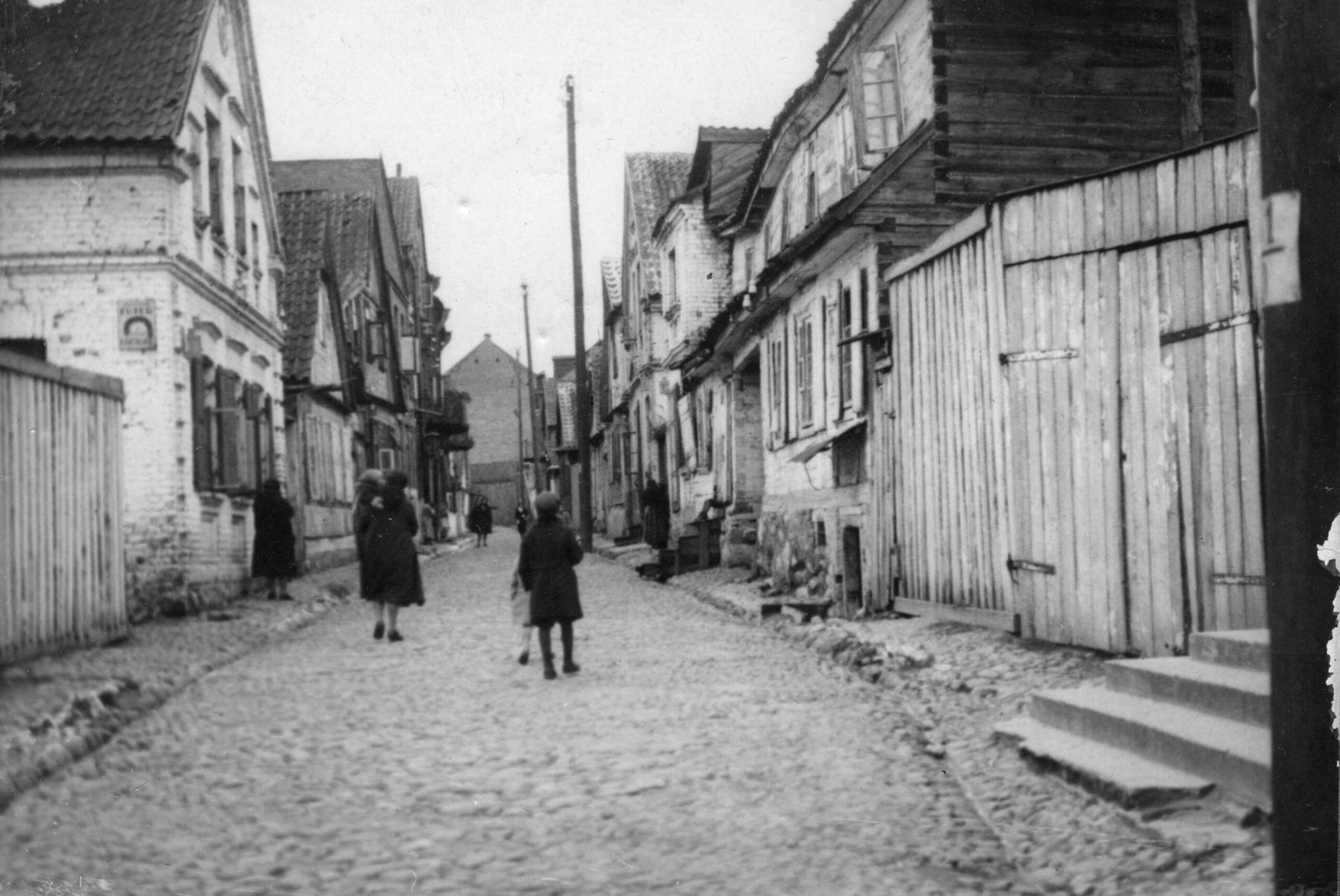
Photograph: Białystok. A street in the Chanajki district
Source: National Digital Archives (Narodowe Archiwum Cyfrowe), Public domain
Link: https://www.szukajwarchiwach.gov.pl/skan/-/skan/b65bc6c162ca3ef1c048ba99cb11674d1e0ac0c9d3470045a5e5665512d9b331